

We Haven't Progressed in Fifty Years

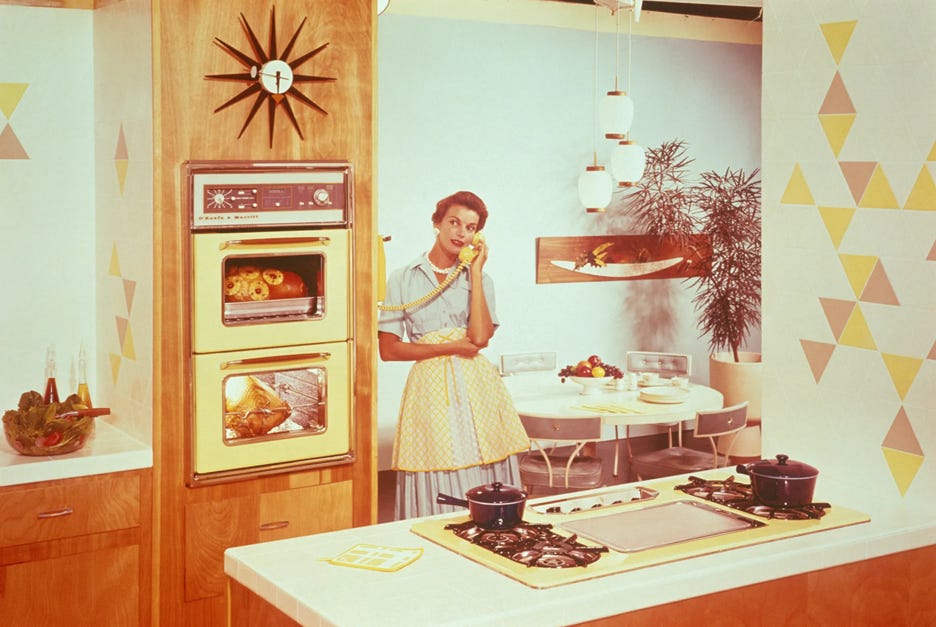
If I took all the screens out of your home, what would be different about it than a home of a similar quality from 1976? The style of the furniture might be dated. You might not like the wallpaper or the shag carpet. The appliances might look old-fashioned, with their yellow hue and lack of LED lights. But they will all do the same thing as the modern appliances. The washer and dryer might even feel better built than the ones you have at home. The doors of the fridge from the 1976 home might have a sturdier feel to them when you open them. And your modern fridge might have been removed from your house when I took away all your screens.
If I were to give you some incentive, would you be able to live in this home just the same as your modern one?
You might miss that multicolored LED lightbulb on your bedside table lamp that turns on and off with Alexa. But, if you had to live in this home from the 1970s, could you live without it? Would you even miss it the next day?
What if I teleported you back to 1976 entirely? Could you live there?
You might miss ending your night with a couple of episodes of your favorite series on Netflix. You might grab your pocket thinking that your phone that is no longer there just buzzed. You might get annoyed by the corded wall phone in the kitchen that you can’t walk too far from while you’re using it. The convenience of texting your friends and family might frustrate you to be without. And sure, it was nice to have power steering and GPS in your car.
But you could do it. And do it without much struggle. Your life might not even look that different. It would be annoying to do some things. But you would have a car, television, kitchen appliances, and telephones. You would also have plumbing, which I couldn’t imagine a 2026 American being able to handle being without for a long period of time. Powering all these things would be electricity. Something we all in the modern day take for granted.
If I took you back another fifty years from then, to 1926, I think you would be less happy. Refrigerators were a luxury for the super wealthy. Heck, electricity was a luxury. Air conditioning? You wish. And I hope you enjoy the radio, because there’s one in the living room if you get bored.
For someone in 2026, 1926 would seem unlivable. However, 1976 is doable with some minor adjustments. It might even sound kind of nice? I mean, imagine a world with no social media. Where you and your friends were compelled to see each other in person. When online content didn’t exist to scare you into clicking on and watching it. And you still get air conditioning and a machine to wash your clothes.
The point being that we have made tremendous progress from 100 years ago. But most of that progress was made during the first half century. People in 1976 were blessed with luxuries and conveniences that the people from 1926 dreamed about. But what did the people of 2026 get?
We made screens with stuff jammed in them, essentially. Computers with websites, phones with apps and TVs with streaming services. And I think a lot of these technologies that we developed harmed society, not helped it.
The modern cellphone sucks more time away from the average human than it provides in convenience and communication. Most of us waste our precious free time binge watching poorly written sitcoms and scrolling through amateurish Instagram Reels instead of connecting with the people around us. The internet as a whole has been a place that, while providing some utility, mostly makes us hate each other.
Outside of the creation of some new things, many of the technologies we have been given are just replacements of an already working system. Just more centralized to benefit the few that invested in it.
Uber just replaced taxis, which were already a reasonable solution to having a driver on demand.
Airbnb replaced hotels, which had already solved the vacation rental problem without jacking up the prices of homes in seasonal areas so that locals could no longer afford them.
DoorDash replaced high schoolers working at pizza places with any immigrant with a cellphone and a car willing to deliver you anything you’re too lazy to get.
Amazon simply replaced local shops owned by people you knew in the town that you lived.
And the modern AI revolution is killing students’ ability to get a real education and destroying a teachers’ incentive to teach.
The people of 1976 dreamed of robot maids in every home and a flying, or at least driverless, car in every driveway. Instead of these blessings of innovation, we got an app to play word games with our friends that we no longer see. It simply does not feel like progress to me. I could live without all these things, and I would probably be happier for it.
I’ve already begun my purge of many of these modern technologies. I deleted all my social media accounts over the course of the past few years. I stopped shopping on Amazon. I’ve never downloaded DoorDash. And I’ve even upgraded to a flip phone.
Every single one of these removals of technology from my life has greatly increased my happiness. I’m more focused, more disciplined, and more connected to those around me than ever before. I go to lunch with friends instead of only DM’ing them on Instagram. I go to my local stores to buy the things that I need. And I sit here and write this article instead of scrolling on my phone mindlessly.
I wouldn’t want to live in 1976. The cars were junk and the music was no good. Computers are an upgrade over typewriters. And I think that the portable flip phone and cell service were all-time great inventions. I think the late 90s to early 2000s were peak human experience. All the modern conveniences that we have today without many of the time-wasting distractions. Sure, the internet was beginning to suck away our humanity, but it wasn’t too bad yet.
We have unfortunately put all our smart engineers to task on building apps that help you, literally, bet on anything instead of creating 300 mile per hour maglev trains that traverse the entire country. We got so scared of having another nuclear reactor meltdown that we stopped the creation of the cheapest, cleanest form of energy our physicists conjured up. Now, we have record high electric bills and smog filled skies over our best cities.
These past fifty years have shown that we are losing our ability to build. Building great things is an inefficient and grueling process. And to build new and useful things, we must take risks. And the shareholders hate risks. So, instead of progress, we must accept that the latest and greatest tech breakthrough next year will be a slightly brighter screen on our iPhone.
But this regression can be stopped. The solution begins with every smart person waking up and realizing they have something real to offer the world. They must begin dreaming of how their skills and talents can build something that makes the world easier to live in. Smart people need to begin to have a revolution on mediocrity. They must turn on their current employer, making them do mindless work with no purpose, and going to work on the most ambitious projects humans are exploring.
The people coding for Kalshi and Polymarket algorithms must quit and join a self-driving car team.
The people engineering iPhones need to turn their gaze to robot maids.
And the people using their spare capital to buy a car wash for the passive income, instead need to help fund young entrepreneurs with big ambitious projects.
Many people wish life was like it was in 1976. Let’s not let the people fifty years from now look back on 2026 and wish that life was like it is now. Let’s fight for progress so that the people fifty years into the future are deeply thankful for the sacrifices we made today so that they can live in unbounded luxury tomorrow.