



Mike Shinoda, co-founder of the famous alternative rock band Linkin Park, is one of the luckiest people to ever live. He was born in an affluent suburb of Los Angeles called Agoura Hills. He was born into an upper middle-class family that owned floral shops. These simple factors alone make his starting point in life greater than almost anyone in the world.
However, in his song “Remember the Name”, created by his side-project Fort Minor, he makes this claim about his career:
“This is ten percent luck, twenty percent skill
Fifteen percent concentrated power of will
Five percent pleasure, fifty percent pain
And a hundred percent reason to remember the name”
Here is what his believed reasons for his success are, visualized:
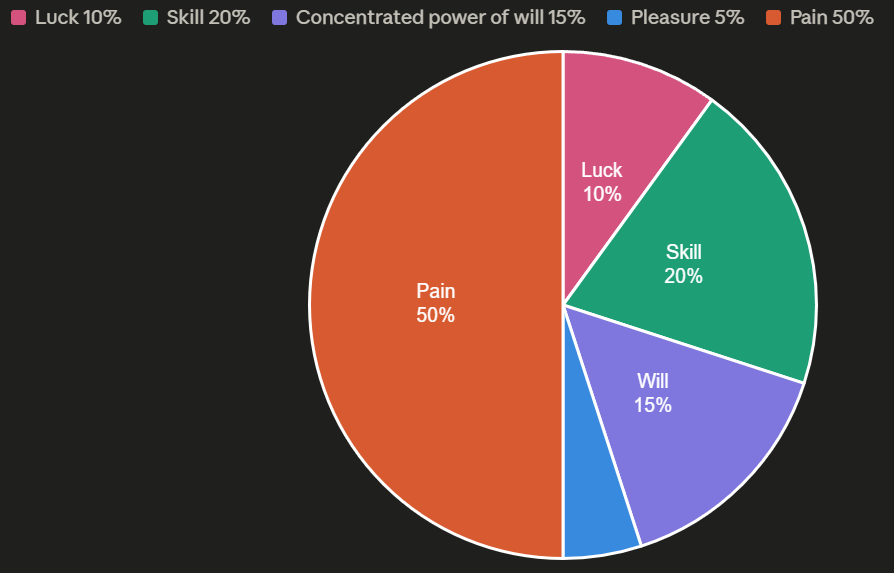
According to Shinoda, a lot of his success came from pain. I’m unsure if this was physical pain or emotional pain. But he has all his limbs attached still and seems to be relatively healthy. I’m happy that despite half of all his success being derived from pain, it didn’t cause him any long-term suffering.
Only 5% of his journey creating music with band members he has worked with for decades in sunny California was actually pleasureful. That seems low, considering the circumstances. But, hey, I wasn’t there. And if 50% was painful, I can’t imagine much of it was all that fun.
And only 10% of his multi-million-dollar music fortune came from luck. For some reason, to me, this feels low. I don’t think Shinoda realizes how lucky he is.
Actually, I don’t think anyone realizes how lucky they are.
I have asked a few wealthy people recently how much they attribute being lucky to their success. Their answers were in the 10-20% range. When I dug down into their responses, I found something interesting: they consider their starting point to be after college, when they were broke and just getting their careers started.
But I don’t think this is the right starting point. Just because your career begins after college (or after high school for most) does not mean that is when your luck begins. In my opinion, your luck begins on day one, when you were born. Luck is measured by the fortunate circumstances you experience in which you had no control over. Where you were born, how healthy you were when you were born, and the income level of the family you were born are your luck.
If I were to guess, most of your luck occurs before the ages of eighteen to twenty-two. This is the point when you enter a stage in your life where you have the most agency over it.
Let’s go back to Mike Shinoda. The internet could not tell me all his fortunate breaks in life. Nor will it tell me all the misfortune. However, if we just take the most certain evidence about his starting point, we get this funnel for his luck compared across all humans in the globe:
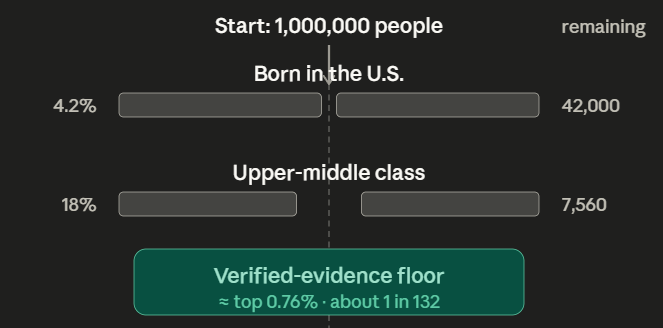
This chart shows that to be born in the US and to be born in the upper-middle class, Shinoda’s starting point is better than 99.24% of the population. If we adjust his success breakdown pie chart to include this new luck calculation, we get this:
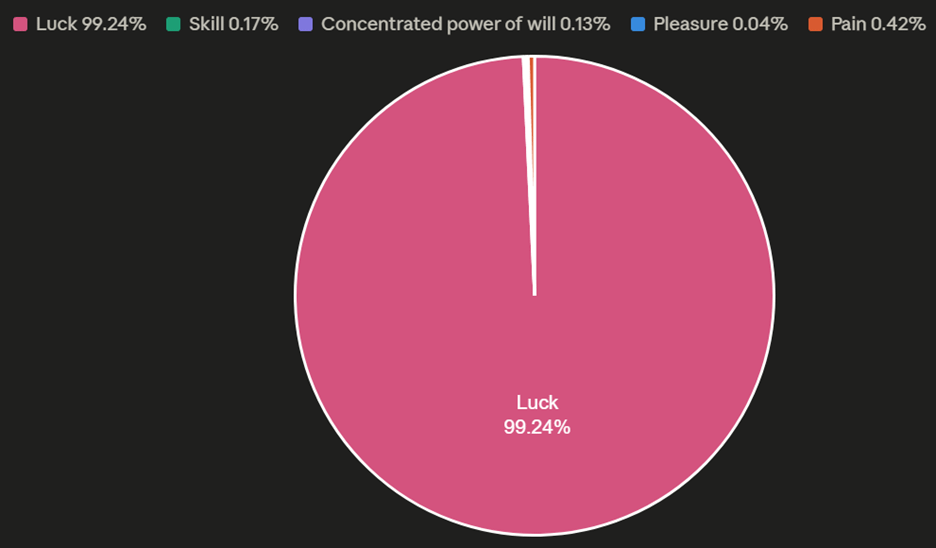
Fortunately for Shinoda, this means his life was only .42% pain. Which seems more accurate considering the complete lack of physical ailments. However, this luck calculation does not consider the fact that at six-years-old his mother made him play classical piano. This incredible musical head start was something he had no control over. The calculation also does not consider the fact that he went to a high-end art college in Pasadena. And it does not consider the fact that he started an alternative rock band in America at the peak of alternative rock in America.
That last point is especially important. If Mike Shinoda was born in the year 2000 and tried to start an alternative rock band in the 2020s, it would not have had nearly the success it had in the years Linkin Park was getting started. He would be like a great sailor with no wind.
Time and place can alter lifetime returns dramatically. Imagine graduating college with a degree in computer science in 2006 versus 2026. In one case, you could be a millionaire in a few years. In the other, you could be desperately searching for a job because AI took your potential future job away.
Forest Gump is the story of a man born into terrible circumstances, but time and place provided him with great fortunes. The movie would be far sadder if that bullet that hit him in the buttocks hit him in the lumbar spine.
(I’m sorry if that Forest Gump line felt out of place. I simply loved the cover image for this blog and had to make it tie-in somehow.)
What if Mike Shinoda was born in Japan, where his father’s family is from? What if his mom never made him take piano lessons? What if he never got accepted to that art college in Pasadena? These are all reasonable alternative timelines that interchange factors in his life that he did not get to choose that would dramatically change his life’s outcome.
My intentions with this article are not to pick on Mike Shinoda (or billionaire tech founders in Silicon Valley who got rich during the dot com bubble building worthless companies, selling them to suckers, and then shaming young people today for buying lunch). My intention is to show you that you are luckier than you think.
Let’s take me as an example. I have a lot of the same luck as Shinoda. I was born to an upper-middle class family in Massachusetts. My parents were married. They paid for my college. And I was born with a non-dumb brain and all my limbs attached in working order.
If you analyze my luck as we did with Shinoda, I’m incredibly lucky. Using the chain rule of probability, we get this chart. Imagine this chart as a funnel, with each factor allowing more or less people to pass through depending on their likelihood:
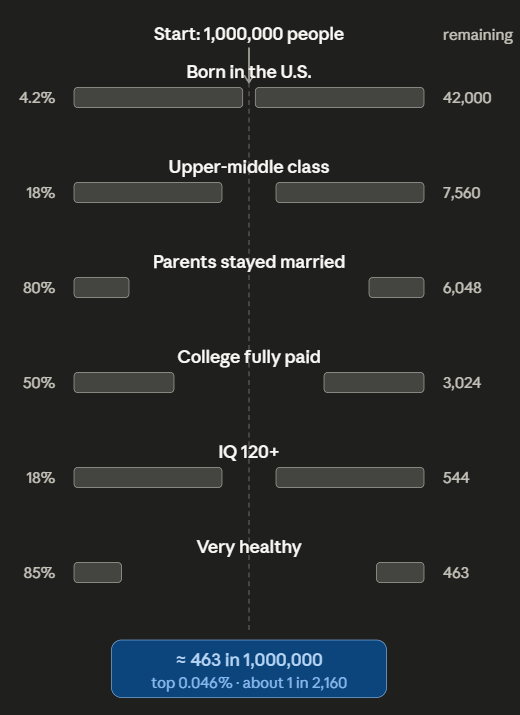
That means my starting point in life is better than 99.954% of the world’s population by the time my career began.
I’m 29 now. I own a gym that is growing at over 30% a year. This year, I will make far more money than the average 29-year-old man in America. I can comfortably afford rent. And I live in a nice, expensive town.
I’m doing okay for myself. However, I’ve also had some misfortune. I started my career as a personal trainer at a gym right when COVID hit and shifted a lot of my industry online. Then I started a gym, a lifelong goal of mine, at the same time when Facebook Ads and other online advertising for gyms became entirely unprofitable. If I had started my gym in 2012, my growth would have been far greater.
As a result of the times, I’ve had to work incredibly hard, almost entirely alone, to will my gym to grow at 30% a year. I’ve been working every day since I bought my gym and only started taking Sundays off to write on this blog one month ago. With the same effort in 2013, I would have had five gyms by now (I’m not being hyperbolic, there’s countless stories of the 20-teens gym-owning cohort raking in massive numbers, mostly built on super cheap Facebook Ads. All those gym owners sold at the peak and now try to scam us modern-day gym owners with their consulting services.)
So, I had a great starting point in life but then a hard starting point for my career. But then, if I consider it another way, my career is built on an industry that scientific studies keep reconfirming to people that they must do. Every new study published on strength training shows that you literally need to pay someone like me to show you how to train the way I train my clients. The way I have structured my gym’s program seems to be trend-avoidant and evergreen. Unless they give you a pill that gives you the results I get my clients with lifting barbells and dumbbells, I always have a business.
And I didn’t go into computer engineering, which was my dad’s degree and my close second option. If I had done that, I would have gotten laid off by now. Choosing my career path, although poorly timed, had luck that I could not have predicted.
People have a natural tendency to give themselves more credit than they deserve. It’s their ego speaking when they cry “oh, poor me” and attribute 10% of their success to luck. It’s easy to discount how much of your success is built upon factors that you had absolutely no control over. Doing so feeds the ego. It also sounds a lot better when asked “How did you get so successful?” that you say “Mostly pain and concentrated power of will,” instead of saying “I was born into fairly wealthy parents that breed me to be a musician in the place where a lot of the music is made in a time where the music I was good at making was the most popular at the time.”
If I reflect honestly, most of my success and future success will be from luck. Do I think it’s 99.954% luck? That, I’m not sure. But I’m confident it is the vast majority. I could have been born into the same family but have been severely autistic. I could have been born in the same town but to a mom who was an alcoholic and a father who beat me. I could have gotten a degree in computer engineering.
If you’re reading this article, you probably share many of the same good fortunes as I. I hope that you finish reading this piece realizing how lucky you are. You are so incredibly lucky. There is no denying that.
The only question left is: What are you going to do with it?
Works Cited
Fort Minor. “Remember the Name.” Genius, genius.com/Fort-minor-remember-the-name-lyrics. Accessed 31 May 2026.
“Mike Shinoda.” Wikipedia, Wikimedia Foundation, en.wikipedia.org/wiki/Mike_Shinoda. Accessed 31 May 2026.